Eric Ries published The Lean Startup in 2011. In the years since, concepts like the MVP, validated learning, and the pivot became so embedded in how founders talk about building companies that it's easy to forget they had to be named in the first place.
His new book, Incorruptible: Why Good Companies Go Bad... And How Great Companies Stay Great, starts from a different place. Not how do you get a company off the ground, but what happens to companies once they're running and why so many of them end up somewhere their founders wouldn't have chosen.
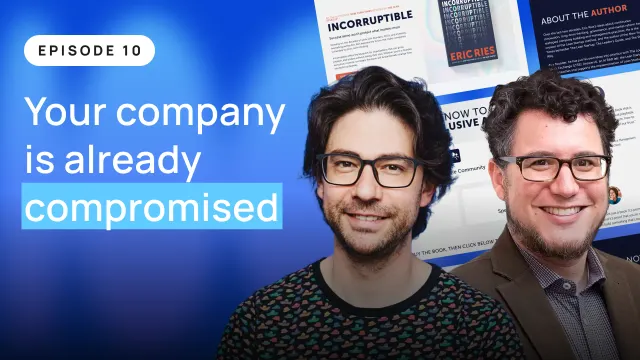
In this episode of The New Build, Eric sits down with Bubble co-founder Emmanuel Straschnov to work through both.
About Eric Ries
Eric Ries is the creator of the Lean Startup methodology and the author of several books including the New York Times bestseller The Lean Startup, The Leader's Guide, and The Startup Way. Over the past two decades his ideas about continuous innovation, long-term thinking, and governance have shaped how companies are built and run.
He has founded several companies including the Long-Term Stock Exchange, Answer AI, and Lean Startup Co, and has served as an entrepreneur-in-residence at Harvard Business School and IDEO. He also hosts his own podcast, The Eric Ries Show.
About Incorruptible
Incorruptible: Why Good Companies Go Bad... And How Great Companies Stay Great is Eric’s latest book. Drawing on two decades of work with founders, CEOs, and investors, he looks at why good companies eventually become something their founders wouldn't have chosen to build, and what you can do to stop that from happening. The book is designed to be used like a manual, offering concrete steps that founders, board members, and even customers can take.
What you'll learn in this episode
This conversation moves between two big ideas: what AI tools are doing to the way founders think and build, and what happens to companies once they start to succeed and why so many of them drift from what they set out to do.
It's a bigger-picture conversation than most of our episodes, but Eric doesn't stay abstract for long. He walks through a specific legal filing any founder can make today to protect their mission and a framework for understanding what your company is truly committed to versus what it just says it's committed to. He also addresses something that will reframe how you read The Lean Startup if you've already read it, and why the two books are more connected than they might seem.
Episode timestamps
[00:00:47] Introduction
[00:02:20] How AI and no-code changed the game Eric predicted
[00:05:20] Why most people use AI wrong
[00:06:00] Dark flow: vibe coding is a slot machine
[00:08:15] The artifact is not the progress
[00:09:30] What Incorruptible is about
[00:11:02] Financial gravity: the invisible force that corrupts good companies
[00:13:35] The Bill Gates intern story
[00:16:23] The FedMart and Costco story: 200 years of companies losing their soul
[00:22:45] When should founders think about governance?
[00:24:58] The "most evil company" exercise: what your charter actually commits you to
[00:27:01] The PBC filing: a two-page fix most founders don't know about
[00:29:15] Mission-driven vs. mission-controlled: the Google "don't be evil" test
[00:33:00] Does Incorruptible conflict with _The Lean Startup_?
[00:35:48] Eric's blueprint: the path of ethos and the path of integrity
[00:40:10] Is Eric optimistic?
Key insights from this episode
Many people use AI to go faster when they should be using it to get smarter
Eric references a controlled study where programmers using AI felt 20% more productive but were actually 20% less effective when measured. His colleague Rachel Thomas at Answer AI has connected this to a concept from addiction psychology called dark flow, the feeling of momentum you get from a slot machine that mimics the sensation of real progress without producing it. When you use an LLM to build something for you, you often understand it less than if you'd built it yourself. When you use it to teach you how to build, you come out ahead over time.
Good intentions are not enough to protect what a company stands for
Companies can lose their way because the structural forces acting on them are stronger than good intentions alone. Eric tells the story of Sol Price, the founder of FedMart, who built a customer-first discount retailer and ran it successfully for twenty years before his own board locked him out of the building. Within seven years the company was bankrupt. Price started again in the same building and what he built eventually became Costco, this time with structural protections built in from the start. Trustworthiness is an asset, and unprotected assets attract people who want to extract value from them.
There's a difference between being mission-driven and being mission-hopeful
Eric draws a line between companies that are committed to something and companies that just say they are. Google has invested heavily in making sure its quarterly reports are filed accurately and on time, every time. The same level of investment doesn't exist around its ethical commitments. Most companies have built the machinery to guarantee their financial obligations and crossed their fingers on everything else. But if you can't show the mechanism, the commitment isn't real.
The Lean Startup was never really about speed
Eric pushes back on how his first book has been read and applied over the years. His view is that The Lean Startup was about going as fast as necessary to learn, not as fast as possible to ship. He connects this directly to Incorruptible, arguing that both books are built on the same foundation, which is an understanding of what you're building and why someone needs it, and with the MVP just one of the ways to get there faster.
Resources
- Incorruptible: Why Good Companies Go Bad... And How Great Companies Stay Great by Eric Ries — Eric's new book, out now
- The Lean Startup by Eric Ries — His first book, introducing the MVP, validated learning, and the pivot
- Answer AI — Eric's co-founded research company focused on tools that help augment human capability
- The Metr study — A controlled trial showing programmers were 20% less productive with AI despite feeling more productive
- The Bubble Academy’s native mobile quick-start course and security course
- Bubble’s YouTube Channel, where we’re hosting live mobile office hours every Friday in May and June
- The recording of Emmanuel’s latest AMA
- RSVP for Josh and Emmanuel’s demo livestream on June 3
Listen and subscribe
The New Build is a bi-weekly podcast exploring how solo founders and small teams are building products that reach millions of users. New episodes drop every other week.
Subscribe: YouTube · Spotify · Apple Podcasts
Build for as long as you want on the Free plan. Only upgrade when you're ready to launch.
Join Bubble