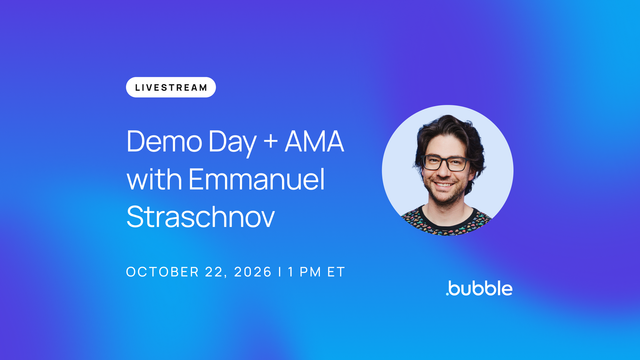
Shortly after Bubble launched Agent 2 and the Bubble MCP (beta), co-founder Emmanuel Straschnov went live for October’s AMA and product demos. He showed the rebuilt Bubble AI Agent, the MCP working inside Claude and ChatGPT, and a way to import apps built with other AI tools. Each gives builders another way to get an app started and keep building it in Bubble. From there, he took community questions and closed by announcing the winners of the Launch Lab Buildathon.
Watch the livestream replay below, or keep reading for a full rundown of what Emmanuel covered.
Everything Emmanuel demoed
Agent 2 brings a full rebuild of the Bubble AI Agent (~3:30)
Emmanuel started with Agent 2, which is a full rebuild of the Bubble AI Agent, covering both the interface and the AI behind it. The biggest gains are on complex requests, like adding a full page or feature to a large, established app. Starting from a vague prompt works well too, since the Agent asks questions, drafts a plan, and has you approve each step, similar to the experience in tools like Claude Code.
The preview now lives inside the editor (~5:45)
The preview button used to open your app in a separate tab, and that option is still there for when you want to see the app exactly as your users would. The new preview tab runs your app inside the editor, with the Agent pinned on every tab. You can preview it as any user in your test database. From there you can ask the Agent questions or request changes, the same as in the design tab. Emmanuel says Agent adoption has risen fairly dramatically since the change.
Building from Claude and ChatGPT with the Bubble MCP (~7:45)
Emmanuel showed the Bubble MCP working inside both ChatGPT and Claude. Once Bubble is added to either tool, you can ask it about your app or have it create things like pages and elements, and the changes happen live in your Bubble app. Emmanuel says this opens up a lot of opportunities for builders to work the way they like. One early example is people using Claude to take an app they built elsewhere and bring it into Bubble through the MCP.
Bringing in apps built with other AI tools (~10:40)
Emmanuel says AI coding tools are great for getting a first version of an app, but if you’re not a software engineer, you’re left with code you can’t easily change. Universal import is the other way in. You can upload an app built with a tool like Lovable, v0, or Replit as a zip file, or bring it in through the Bubble MCP, and Bubble generates a Bubble app from it that you can change visually in the editor. Emmanuel showed a finished example, an app a teammate built with Base44 and then imported, with its workflows in place.
A smoother path to the app stores (~12:40)
The mobile team has made submitting to the stores more guided. Connecting to the App Store and the Google Play Store now walks you through each step that's needed. Emmanuel was upfront that the process is still not simple, especially with Apple, which has a lot of requirements an app has to meet, and says the goal is to make it as streamlined as possible.
The Agent checks its own work (~14:00)
The Agent is now better at reviewing what it builds. It uses the issue checker to look for errors its changes might have introduced, and takes screenshots to see whether the result matches what you asked for. Emmanuel says this cuts down on how much you need to double-check.
Faster page loads and a more scalable scheduler (~14:40)
Pages with reusable elements now load much faster, since more work is deferred rather than processed right away, and more page load improvements are in progress. On the scheduler, the tool for running actions and workflows later or on a recurring basis, the team has worked on scalability and reduced unnecessary database overhead.
For apps running a lot of scheduled workflows at scale, Emmanuel says that should make a meaningful difference in how reliably and quickly they run. He also encouraged builders to keep flagging slowdowns on the forum.
What's coming next (16:01)
Emmanuel closed the demos with what's in progress, and says the team has reached a pace of shipping that lets it work on many things at once.
- Branching and loops in workflows are in alpha now, with a beta planned for later in November.
- The Agent will be able to work with version control, like comparing and managing branches, and to access live data if you give it permission. Emmanuel expects that within a couple of weeks.
- A native way for Bubble apps to call LLMs is also in the works, without needing a plugin or the API Connector. Emmanuel says there will be ways to monitor usage, and he didn't give a timeline.
- The redesigned data tab, with a new grid and inline editing in place of today's pop-up, is expected in the next two to three weeks.
- The mobile team is working on performance and reliability fixes, along with splash screens and animation, expected in about a month.
Questions from the community
How to learn Bubble with the Agent and the MCP (18:40)
Asked how new users should learn Bubble with the Agent and the MCP now available, Emmanuel said that with any tool, understanding how things work behind the scenes pays off eventually, the same way learning code helps if you use Claude Code.
His advice is to get your app up with the Agent, then click around to see what it built and ask the Agent to explain it, including by clicking a workflow or button in the editor and asking about it directly. Learning how workflows fit together will matter as you scale, but not on day one.
Native mobile questions (~21:15)
Emmanuel considers native mobile mature enough for large commercial launches, with more performance and reliability work on the way, and invites anyone with a particularly large project to reach out to the team (~21:15).
A native glass tab bar for iOS apps and animations for mobile apps are both requests Emmanuel will take to the team, with a response likely to come on social media. He says requests like these are useful to hear as the team plans its next round of mobile work (~25:20).
Performance on lower-powered phones is best addressed by building with the native app builder rather than wrapping a Bubble web app, Emmanuel says, since native always performs better. He can't guarantee everything will work on every device, but if you hit a blocker you can reproduce, he asks you to get in touch, since the team tests on a wide range of devices (29:08).
Starting with web or going native is a long-running debate, and Emmanuel's own view is to start with web, since it's faster to iterate without store submissions, especially at the prototype and MVP stage. Some apps, like a dating app, work better as native from the start because people expect to use them on their phone. Moving from web to native takes some tweaking, but plenty carries over, and AI can do much of the heavy lifting (37:52).
A product tracker rebuilt through the MCP (~21:55)
Asked about the best MCP use case he's seen, Emmanuel noted that it has only been out for two weeks, so examples are early. The one he shared came from inside Bubble. The team had a product tracker, built outside Bubble, that showed its projects, roadmap, and timelines. A teammate who isn't an engineer used the MCP to rebuild it on Bubble, and the team now uses the Bubble version. Emmanuel says the speed of the build was exciting to see.
Workload costs as your app grows (39:22)
Workload is a sensitive topic, Emmanuel acknowledged, since people worry their bills will climb as activity grows. His advice is to reach out if you start seeing significant usage, since Bubble's enterprise team can offer custom pricing with a bigger allotment and more predictable bills. He says the team keeps monitoring how workload units are consumed because it wants builders to feel good about scaling, but doesn't want to move too fast on changes. Paying more as usage grows is normal, he adds, and it usually means there's revenue to cover it, so he suggests focusing on monetization.
Ownership when working with an agency (41:46)
Asked how to keep full ownership and control of an app built with an outside agency, Emmanuel said it comes down to the legal agreement and being clear about what's delivered. "If it's code, it should be code. If it's a Bubble app, it should be in your Bubble account," he says. On the functionality side, he thinks a visual app lets you take over more readily, especially if you use the Agent to understand it, since you can make changes yourself. On the legal side, he suggests collaborating with the agency productively and being careful about what you sign.
Shorter answers
Data processing agreements are something Bubble signs under some circumstances, Emmanuel says. A builder in Germany asked about regulating access to customer data, and he suggested contacting the support team, who can point you to the right person (22:35).
The AI testing lab shown in June hasn't shipped. It's an AI-assisted way to build integration tests, such as checking that a signup flow still works. Emmanuel says it was deprioritized while the team focused on Agent 2 and the MCP, but testing is still on the roadmap, and the team is reconsidering when to ship it (24:17).
Accidental loops that repeatedly call external APIs can't be stopped automatically, since there are cases where you want a loop to run. Emmanuel points to the notification system in the editor, which alerts you so you can react quickly (~25:50).
Making global expressions private is a request that has come up before, and Emmanuel will raise it with the team. His view is that an expression should be about logic rather than data, so ideally nothing sensitive lives in one (~26:50).
Theme-based variables, where one variable has different values per theme, don't have definite plans yet, but Emmanuel says they're on the list of ways to make the editor more flexible. The team is focused on branching and the new data tab for now (27:39).
Race conditions between workflows touching the same data are something the team is working on, though Emmanuel isn't sharing a timeline because it's a significant project. He says it's important, even though it doesn't come up that often in practice, and that recent database work is leading the way to a fix (28:14).
Payment currencies for African markets could likely be covered with plugins, Emmanuel says. If a payment provider suits those markets, he doesn't see a reason it couldn't be added as a plugin (31:02).
Pre-rendering is on the roadmap, and the scale team is working on it with performance and SEO in mind, but Emmanuel isn't sharing a timeline since plans can shift (33:03).
Regional pricing isn't something Bubble offers, Emmanuel says, because the team and its costs are in US dollars. Student discounts are available anywhere in the world for anyone who gets in touch, and he encourages thinking about monetization early, since an app eventually needs to cover its hosting costs (34:43).
HIPAA support is now available in the US for builders creating software that handles patient data. It goes through Bubble's sales team because it involves paperwork, so it isn't a setting you can switch on in the editor, and he points people to the bubble.io/hipaa (36:42).
The Agent finding places to use branching and loops is something Emmanuel wants to do, but branching has to ship first. Once it does, he expects the Agent team to look at it, since the aim is for the Agent to help apps perform better and be simpler to maintain. When he says branching, he means loops too (~43:20).
Tech support after launch is available, particularly on paid plans, though the team also responds to Free plan users. Emmanuel points to the support chatbot at bubble.io/home as a first stop, and says Team plans and above include a consultation service with audits for your app. Bubble can't do one-on-one sessions for everyone, but if you hit a specific issue, the team will help where it can (44:40).
The Launch Lab winners (~46:30)
Emmanuel wrapped up the livestream with the winners of the Launch Lab Buildathon, a competition with cash prizes for the strongest apps. The program ran weekly office hours from Bubble's team to help builders get from an idea to a working app. A panel of judges reviewed the submissions, and he announced the winners (~47:50).
- The Launch Lab Prize, the program's top prize, went to Seth Barrett and Matty Weibel for WeChef, an app that takes meal planning, usually something you do alone, and makes it social. You follow people whose cooking you trust, see what they're planning to eat that week, borrow the meals you like, and share your own plan back.
- Best web app went to Stefan Pointecker for studiwohnen, an app that puts more than 1,500 residences and over 200,000 rooms across Germany, Austria, and Switzerland in one search. Students narrow it down by city, room type, and budget, then request a room straight from the listing.
- Best mobile app went to Valentina Valera Vella for Droom, an app that lets you capture a dream by voice or text before it fades. It turns the dream into AI-generated artwork and gives you a community to share it with.
Emmanuel also recognized the other builders on the leaderboard, which rewarded sharing work and supporting each other. He added that not being on the slides isn't the only way to succeed on Bubble, and that builders can share their work on the forum or reach out to the team, who are happy to showcase apps built on the platform. He closed by encouraging anyone with an idea to start, since getting started is free.
Full question list with timestamps
0:02 — Welcome and introduction to today's demos
~3:30 — Agent 2 and the rebuilt Bubble AI Agent
~5:45 — The preview now lives inside the editor
~7:45 — The Bubble MCP in Claude and ChatGPT
9:11 — Demo of asking Claude about an app through the MCP
~10:40 — Bringing in apps built with other AI tools
~12:40 — A smoother path to the app stores
~14:00 — The Agent checking its own work
~14:40 — Page load and scheduler performance
16:01 — What's coming next
~18:30 — Demo wrap-up, transition to community questions
18:40 — How should new users learn Bubble with the Agent and the MCP?
~21:15 — Is native mobile mature enough for large commercial launches?
~21:55 — What's the best use case of the MCP so far?
22:35 — How can we regulate access to customer data through a DPA?
24:17 — Any update on the AI testing lab shown in June?
~25:20 — Will Bubble support a native glass tab bar on iOS?
~25:50 — Are there safeguards against accidental loops that call external APIs?
26:23 — When will animations come to mobile apps?
~26:50 — Can global expressions be made private?
27:39 — Can variables have different values per theme, for dark mode?
28:14 — When will race conditions from concurrent database updates be fixed?
29:08 — How do native apps perform on lower-powered phones?
31:02 — Will more payment currencies be supported for African markets?
33:03 — When is pre-rendering coming?
34:43 — Is there regional pricing or a student discount?
36:42 — What's the status of HIPAA support?
37:52 — Should we launch as a web app first or go native?
39:22 — How can we prevent unexpected workload costs as we grow?
41:46 — How can we keep ownership and control when using an outside agency?
~43:20 — Will the Agent find places to use branching and loops?
44:02 — What about loops?
~44:15 — Can apps call LLMs natively, with ways to monitor usage?
44:40 — What tech support is available on paid plans?
~46:30 — Launch Lab recap and the Buildathon
~47:50 — The Launch Lab winners are announced
~50:00 — Leaderboard shoutout and closing remarks
Build for as long as you want on the Free plan. Only upgrade when you're ready to launch.
Join Bubble