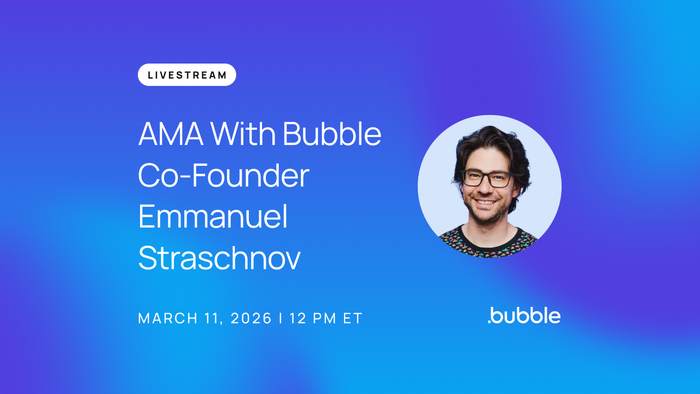
March's AMA brought a room full of product questions — and Emmanuel had a lot to say. From a concrete rollout timeline for the AI Agent in existing apps to a frank take on where Bubble stands in the vibe coding era, here's what came out of the conversation.
Questions about the AI Agent’s rollout and roadmap
The most consistent theme across this AMA — as with past ones — was the AI Agent. Specifically: When can builders use it in apps they've already built?
The short answer is soon. Emmanuel broke down the rollout in phases. Blank apps that weren't created through Bubble's AI generation flow will be able to access the Agent by the end of March or early April. From there, the team plans to open access to agencies and ambassadors first — partly to manage server load, partly to collect feedback — before expanding to paying apps and then more broadly over the following three months.
"What is good for our users is also good for us here," Emmanuel said, "because the faster people can learn Bubble or iterate on the application, the better it is for everyone. We just want to do that in a controlled manner to avoid problems."
The Agent itself is also continuing to grow. Today it can generate and edit UI, dynamic expressions, data types, and workflows. The goal is to reach parity with everything you can currently do with a mouse and keyboard — and from there, move toward proactively suggesting architectural best practices for more complex, scalable apps. "One thing we pride ourselves on at Bubble is building for production," Emmanuel noted. He also shared that roughly half the challenges users run into stem from apps that had some structural issues from the start — so there's a lot of alignment between what the Agent can help with and where users actually get stuck.
On the question of using external tools like ChatGPT or Claude to talk directly to Bubble via MCP: it's on our radar, but not on the roadmap yet. Emmanuel wants to invest in Bubble's own agent first — get it to a competitive baseline — and open the editor API once the architecture is stable enough to commit to. As he put it, focus is everything right now.
Workflow editor: Branching is coming
Conditional yes/no chain splitting in the workflow editor — one of the most-requested features — is in development. The new workflow tab released last year was actually built in part to create the physical space on screen needed for branching. But Emmanuel set clear expectations: It's not arriving in the next two to three months.
The complexity here isn't just visual. "From your point of view as users, it might feel like it's just a visual thing in the editor," Emmanuel explained, "but it's actually more complicated because we need something that works in production." There are real engineering questions to work through — like what happens to an action that depends on the result of a branch that didn't run. The team is doing careful work to get it right.
Mobile: More access to the Plugin editor coming in April
The mobile plugin editor is the top priority for mobile right now, alongside general performance and reliability improvements. Emmanuel confirmed the team expects to start opening up beta access sometime in April — and when it does, it won't require an invitation to participate.
"Similarly to how I don't want the Bubble team to invest in a new date picker for web [because there are so many great community-built date picker plugins], I'd also like the community to come up with great things for mobile," he said. The plugin editor is essentially the same bet for native apps: Let the community extend the platform with React libraries and custom components instead of centralizing everything in Bubble's roadmap.
On App Store publishing: While working with Apple's review process can be challenging — the bar is high and individual apps do run into review friction — Emmanuel said this isn't a Bubble-specific problem. The team is seeing a healthy volume of apps being published successfully.
Platform updates: Debugger, API connector, and more
A few other notable topics from the session:
Debugger improvements are in progress, with a focus on integrating the Agent more closely so it can observe how workflows execute and suggest fixes. The mobile debugger already received a significant upgrade; web improvements are being informed by that work. For enterprise customers who need more robust observability, the team has been sharing some of the platforms Bubble uses internally — reach out if that's relevant to your situation.
API connector updates are also underway. The connector has moved to its own tab with a refreshed design, and a key focus area is handling nested JSON — especially for LLM APIs. If you've hit walls trying to access specific values from API responses, that's something the team is actively working through.
Workflow action-level disabling (distinct from disabling an entire workflow) is on the list. It's not clear how high yet, but in the meantime: Adding a condition that never evaluates to true is a viable workaround for debugging.
Multiple environments beyond the current development and live setup is something the community has been asking for. Emmanuel acknowledged it's a meaningful architectural change at Bubble's scale, but flagged it as something worth tracking.
Bubble's position in the vibe coding era
Emmanuel was candid about where Bubble stands competitively. Top-of-funnel isn't the concern — the wave of attention around AI-powered app building has actually worked in Bubble's favor. More people than ever are hearing that building without code is possible, which drives interest in the platform.
Where there's real work to do is the early product experience. "Transparently, our AI offering is not yet at par with some of the AI-first companies in our space," Emmanuel acknowledged. "That's where we need to invest to ensure that we convert people better and the product is easier to learn." He encouraged builders to try Bubble's AI generation again if they haven't recently — improvements from new models and internal engineering work have made it noticeably faster over the last few weeks.
The structural advantage Bubble holds, though, is one he returned to several times: Vibe coding tools built on generated code hand users control they can't actually use. When something breaks and you can't read the code, you're stuck — especially under pressure with real users depending on your app. "Our goal is to offer more control than other options offer, because we're not code-based," he said. "Code gives you the illusion of control."
On the business model front: Bubble's model is more diverse than platforms that monetize primarily on AI token usage. The hosting business provides meaningful stability — and as Emmanuel put it, token consumption fluctuates, while hosting is steady.
The future of Bubble freelancers
Emmanuel closed the session with a question worth sitting with: As the AI Agent gets better, will there still be demand for Bubble freelancers and agencies?
His answer was yes — with a caveat. The nature of the work is changing. A lot of the more repetitive, task-level work will increasingly be handled by AI. But the need for people who know how to build things well won't disappear. He compared it to tax professionals in the age of AI-assisted filing: The job changes, but expertise still matters, and the stakes on a production app are real enough that people will still want someone who knows what they're doing.
"More people trying to build applications with Bubble means more need for services," he said. His advice to freelancers and agencies: get familiar with the Agent and its capabilities now. "The more you are aware of the latest capabilities of the tooling in Bubble, the better you'll understand where you can add value as a human and not as a computer."
His prediction: demand for Bubble freelancers three years from now will be higher than it is today.
Full question list with timestamps
00:00 Introduction & Welcome
00:09 Conditional Branching in Workflow Editor
02:10 Refund & Billing Issues
02:45 Bubble vs. Vibe Coding Tools (Lovable, etc.) & User Acquisition
04:23 Lessons Learned as a Founder
06:03 Disabling Individual Workflow Actions
07:15 AI Suggesting Architectural Best Practices
08:05 Editing Existing Apps with the AI Agent
10:32 Improving Bubble Logs & Debugger
12:17 Native Date Picker, Dropdowns & UI Elements
13:30 Multi-Language Support (Turkish & Others)
14:53 Graphic UI vs. Script/Prompt-Based Building
16:08 SEO & Performance for Bubble Apps
18:19 Is Bubble for Prototypes or Production?
19:45 Speed to First Prototype vs. Control (User Comment)
21:25 Mobile Plugin Editor Timeline
22:08 Exposing MCP / API for Third-Party Tools (BuildPrint)
24:27 Has AI Changed Bubble's Average User Profile?
26:28 Which User Segment Is Bubble Prioritizing?
28:00 Mobile App Password Manager Support
28:31 API Connector Schema & Nested JSON Improvements
29:45 MCP Server to Connect LLMs Directly to Bubble
30:33 Biggest Challenges with the Mobile App
32:25 Does Bubble's Business Model Have a Future Amid Vibe Coding?
33:56 Plans for More Than Two Environments (QA/Staging)
34:44 Can Prompt-Based Prototypes Become Real Production Apps?
36:33 Native Mobile Plugin Editor – Follow-Up
37:16 Plans to Make the Database More Relational
38:05 Do Users Own Their Bubble Applications?
39:18 AI Creation of Option Sets
40:01 Bubble Developers vs. Traditional Code Developers with AI
41:37 Using Claude/ChatGPT in Existing Bubble Apps
42:39 Can Bubble Freelancers Still Earn Money as AI Improves?
46:03 Wrap-Up & Goodbye
That's a wrap on the March AMA. Watch for the Agent rollout to existing apps over the coming weeks, and keep an eye on the forum for updates on the mobile plugin editor.
Build for as long as you want on the Free plan. Only upgrade when you're ready to launch.
Join Bubble